SGH Patient Gown
Usability Study
A human-centred wrap gown designed to make orientation clearer, dressing more independent, and clinical access more targeted without giving up coverage.
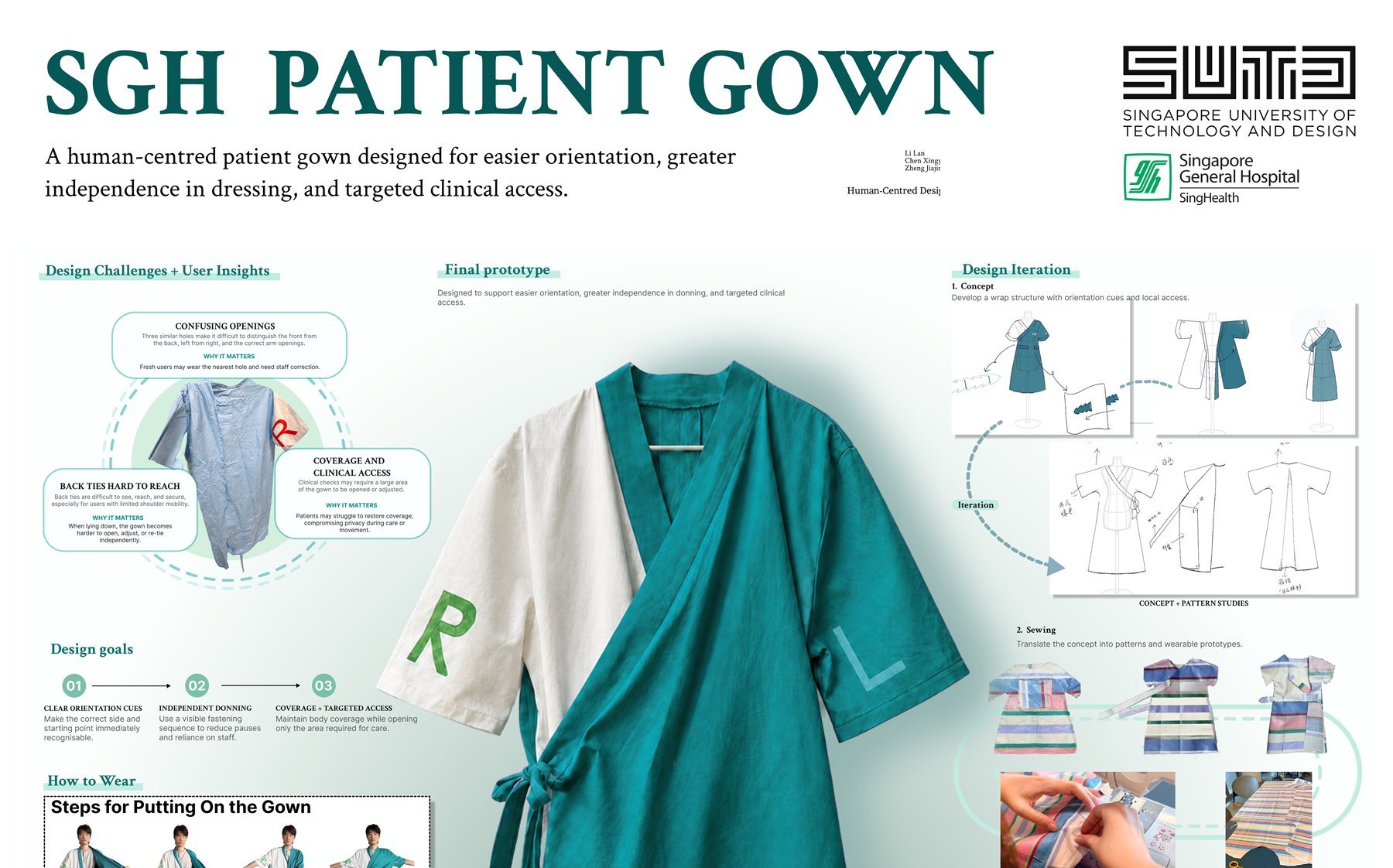
A familiar garment hides several moments of friction.
Traditional patient gowns can make orientation ambiguous, place ties outside a patient’s comfortable reach, and force a trade-off between clinical access and personal coverage.
The team reframed the brief around three practical goals: make the correct starting point immediately recognisable, support self-dressing with visible and reachable fastenings, and open only the area required for care.
Three breakdowns became three design requirements.
- OrientationSimilar openings made the front, back, left, and right difficult to distinguish at a glance.
- ReachBack ties were difficult to see, reach, and secure—especially with limited shoulder mobility.
- CoverageLarge openings improved access but exposed more of the body than the task required.
- Design criteriaClear cues, independent donning, and localised access needed to work as one garment system.
A wrap structure turns orientation into something the garment explains.
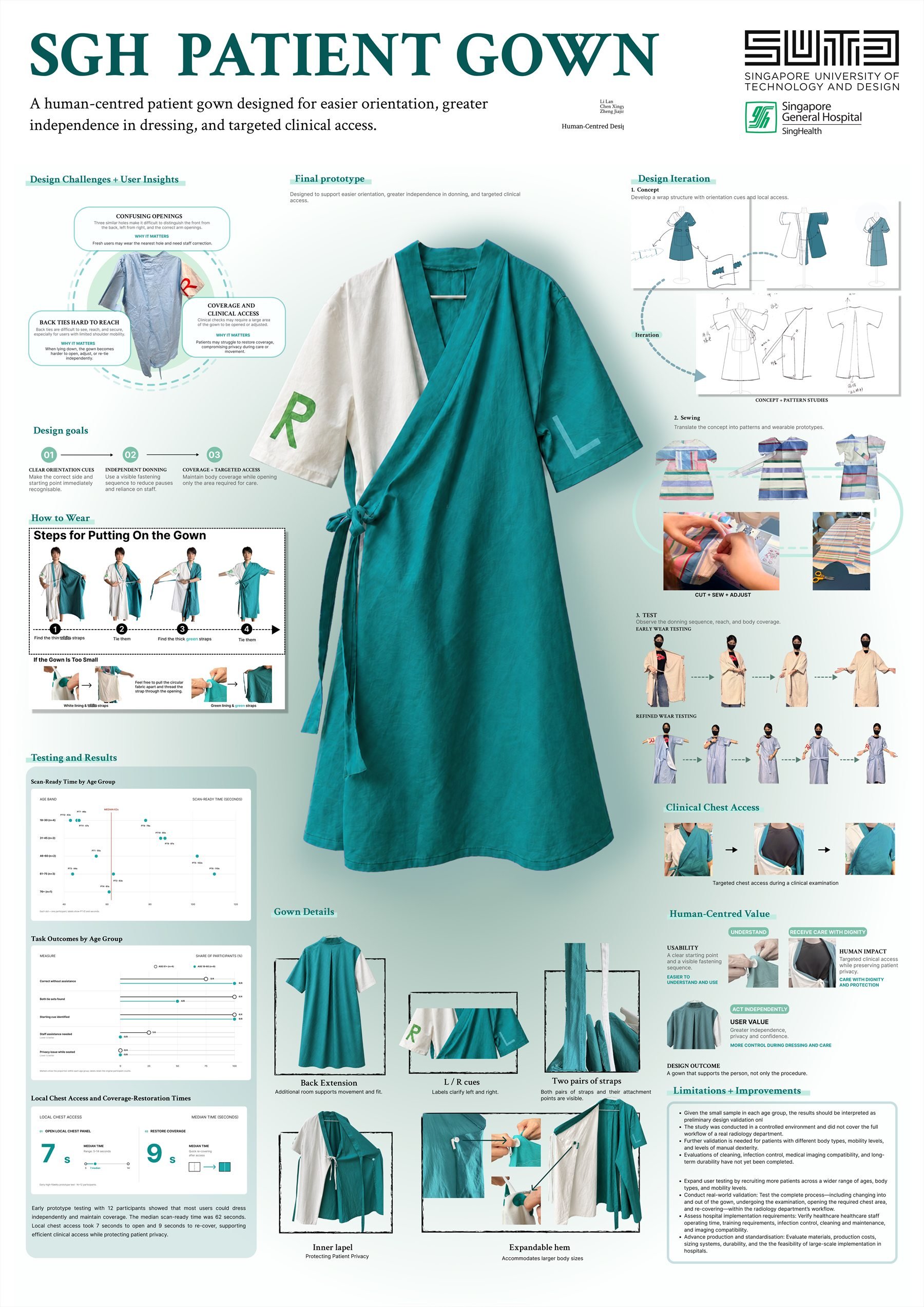
The final prototype uses contrasting panels and large left/right sleeve cues to create an obvious starting state. Two reachable strap pairs support self-fastening. An inner privacy panel and expandable hem preserve coverage, while a local chest opening allows targeted access.
- 01Sketch wrap structures and orientation cues
- 02Translate concepts into garment patterns
- 03Cut, sew, wear, and adjust
- 04Refine fastening, coverage, and local access
Test the dressing sequence—not just the finished garment.
Early prototype testing involved 12 participants. Most users were able to dress independently and maintain coverage. The recorded median time to become scan-ready was 62 seconds; local chest access took 7 seconds to open and 9 seconds to re-cover.
The prototype is promising as a clearer, more self-manageable dressing sequence with fast local access. These results support continued iteration; they do not establish clinical effectiveness.
Promising in a lab is not the same as proven in a clinical workflow.
This was a small, preliminary design validation in a lab setting with healthy volunteers. It did not validate radiology workflow, infection-control requirements, laundering durability, sizing coverage, or use by patients with relevant mobility limitations.
The next phase should combine representative-user testing with clinician observation, repeat laundering, multiple body sizes, and a workflow comparison against the current gown.
The strongest intervention was not a new feature in isolation. It was making orientation, reach, coverage, and access reinforce one another across the entire dressing sequence.